THE HIDDEN ISLE
For #CharacterCreationChallenge Day 9, I’m taking my spouse Lore’s recommendation and giving The Hidden Isle, by Causa Creations, a bash. It’s “a tarot RPG of sorcery and adventure”, and has a quote from Hermes Trismegistus as an opener, which are all good signs.
It’s set in the sixteenth century and uses Forged in the Dark mechanics, with some adaptations for tarot, because this is a game driven by tarot rather than dice. Players are Agents of Dioscoria, the Hidden Isle, who go on swashbuckling adventures to defend the island’s values: protecting the helpless and preserving knowledge. Lore is correct: I am going to like this, I suspect.
There’s a lot of stuff I like about Blades in the Dark, but the one time I ran it, it did not go down brilliantly so I suspect there’s some stuff I just don’t get. Maybe this will help me puzzle it out.
Let’s Do This
Before we start: this book is gorgeous. The standard for RPGs is rising all the time, and people keep smashing it. Depressing if, like me, you’re a self-taught graphic designer who only got started so they could knock out a book that wasn’t completely embarrassing. The art is Jungendstil-inspired (the German/Austrian part of the art nouveau movement), and that’s a long-time favourite of mine.
Just based on the introduction – a single page – I’ve got a rough idea what type of adventures I’m likely to be going on, and I’ve got enough of a grasp on sixteenth century history to dive right in. I hope.
Character creation recommends coming with no preconceptions and letting the cards guide you. If you’ve been following this series of blog posts, you’ll know this is music to my ears. Can do, Causa Creations. Can do.
One minor quibble: the step-by-step guide is spread over two pages, and it really didn’t need to be. With a slightly more tailored bit of graphic design work, it could have easily fit on one page, which is much easier to refer to – or to print out and stick on the table for players.
My mild irritation about this is countered by the conveniently packaged useful info that precedes character creation: how Agents are expected to behave, how they travel, and how they communicate with one another. This is all super helpful in making someone who’s actually going to fit the game.
Step 1: Class
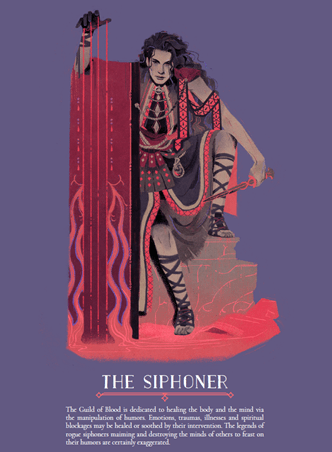
All the classes start with full page illustrations and summary descriptions. Yes. Good. I do question why there’s a whole class (The Hunter) devoted to murder, when that’s something Agents are specifically not supposed to resort to.
Out of all the options – a nice blend of magic and swashbuckling, from occultists, to scoundrels, to actors, to knights errant – I’m choosing a Siphoner: Medics and healers who study the four humours.
See how nice this art is?
Step 2: Core Self
This is a pair of questions, answered by drawing from the Vision deck (the tarot’s Major Arcana and court cards):
- As a child I solved problems through… [Death]
- As an adult I survived/flourished by… [The World]
There’s another section for Fulfilled Virtues, but I assume that comes into play later. There’s a Character History table at the back of the book to interpret these cards. Since I’ve got a bookmarked PDF it’s easy to find, but I’d have loved a page reference.
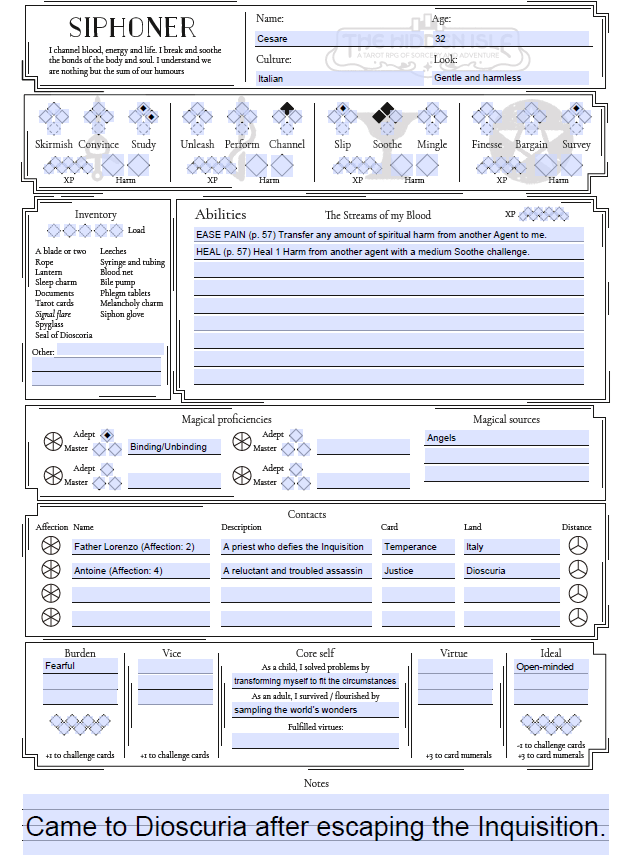
One of the meanings for Death is “transforming myself to fit the circumstances”, and I like that: it sparks a character who spent his youth force-fitting himself to the world around him – and went to Dioscuria so he could stop doing that, and be himself. He’s queer, obviously. All my characters are.
A listed meaning for The World is “sampling the world’s wonders”, and I like that one too. Someone who’s grown into finding those strange corners and edge cases where people like him – magicians and outsiders – can flourish, and embracing them.
Step 3: Burden
The previous step suggests an appropriate adjective for my Burden, my character flaw. Fearful. He doesn’t fully trust the world outside Dioscuria. He considers it dangerous and threatening, because that’s been most of his experience of it. He’s overly cautious and sometimes reluctant to act in case it puts him in danger or makes the situation worse.
Step 4: Ideal
This is the principle he lives by. Like Burden, I’m free to make it up or choose it from the Vision deck. I do that: as always, introducing some randomness will make a more complicated character.
I get the Hanged Man: Surrendering, Open-Minded, Sacrificing, Seeking. Open-minded works well, I think. He may not fully trust the world, but he’d like to think the best of people, and he actively seeks out the strange and the outcast.
As an aside: tremendous respect for the writers, because listing out this many character traits that are interesting and gameable is not easy.
Step 5: Abilities
I want him to be primarily a healer, rather than someone who alters minds, so I take Ease Pain and Heal (which are pretty self-explanatory, I think). You could also play someone who inflicts harm, or who uses their own humours to adjust their abilities.
Again, there are a couple of quite nasty, damage-focused abilities in here that seem at odds with what the game wants Agents to do. I can’t tell if this is a deliberate tension or not, so I’ll give them the benefit of the doubt.
Step 6: Skills
Three skill points are already assigned by class. I get another two to distribute to reflect my Core Self and two more to put wherever I want. Soothe (which looks like the core skill for my Siphon abilities) is already at 2, the highest it can go at character creation. I pop 2 points into Study – he’s a learned man – and 1 into each of Slip (he’s good at blending in) and Survey (staying out of harm’s way means staying alert).
Step 7: Magical Proficiency
I’m onto the second page of the character creation summary. I have to say, for quite a lengthy process it’s smooth as butter. This is not taking much time at all, and I’m getting a pretty good feel for the character.
Occultists, Illusionists and Siphons all get a magical proficiency by default – but other classes can have one if the player wants. It’s that simple, and I approve. Let’s be honest, playing someone without magic in a game that’s about magic is not fun.
Two things happen at this point: it takes me ages to find magical proficiencies (there’s no page reference, and they’re not in the index. Rude.), and I find out how magic works in Hidden Isle. Agents have broad areas of magical competence (or proficiency), and using magic often causes them harm. These are both aspects of magic systems I enjoy, so I forgive the book for making me hunt them down.
Now, I could just take Brigomancy – damage transference – but that’s too easy, and looks like it replicates what my Siphon abilities do. Instead, I choose Binding/Unbinding: I like the idea that he learned his special skills from an angel, whom he still associates with.
Step 8: Name
…and other details. I’ve already decided he’s Italian, because I remember from Mary Gentle’s Ash novel there being a major medical school in Salerno. I shall call him Cesare.
For his appearance, I’m just going to say “gentle.” He looks harmless. Moderately attractive, somewhat youthful, and like he not only couldn’t hurt you but doesn’t want to.
Step 9: Arrival in Dioscuria
A couple of the games I’ve made characters for haven’t put a Notes section on the character sheet, and I have always needed one, so I’m pleased that it’s here and also that Hidden Isle wants me to use it to record my origin.
Cesare came to Dioscuria after escaping the Inquisition, which is hard at work in this setting. And that’s going to come back into play next step.
Step 10: Contacts
The last step is making two contacts, one from before Dioscuria and one from the island.
My pre-Dioscuria contact is Father Lorenzo, a kind-hearted priest who helped Cesare slip free of the Inquisition, and told him of a rumoured island where people like him could live well. Now, I was supposed to do this with a draw of 3 Vision cards, but instead I’m going to use the cards to flesh out this character.
- The World (journeys, completion, accomplishment, growth; travellers and seekers)
- Temperance (balance, patience, contentment, purpose; sages)
- The Emperor (order, law, duty, discipline; kings and leaders)
These cards could easily have made the character I had in mind anyway. I didn’t cheat, honest. As well as being a kind and temperate man, the card draw suggests Lorenzo’s doing more than helping the odd person escape the Inquisition: he actively (though quietly) resists it. Perhaps he’s even seeking to bring it to ruins.
I need to choose one of the cards to represent him, and I think Temperance is the most obvious: patience, purpose, and balance matter more than his determination and leadership. He too is from Italy. He’s only an acquaintance, so I fill in 2 of the Affection clock’s 8 segments.
Next is my Dioscuran contact. I don’t have an idea for this, so I’ll let the cards lead me.
- The Devil (entrapment, desires, contracts, freedom; conmen and lawyers)
- The Hanged Man (sacrifice, surrender, suffering, new perspectives; scapegoats and ascetics)
- Justice (balanced, merciless, karmic, revenging; judges and angels)
I’m going to take a cue from what the book implies but doesn’t say: violence and harm are a tool, and I suspect Dioscuria uses it more than the top level advice makes out. This man’s an assassin and executioner, but one who regards himself as doing a necessary but ugly job, trapped in it because he wouldn’t want to put the burden on anyone else. I think he hates himself. He’s a close friend: he finds Cesare’s patience and calm soothing, and Cesare’s one of the few people reluctant to judge him. I shall call him Antoine.
I… really like this character. There’s enough randomness in this process to take me interesting places, and the prompts and sparks are really well-constructed. They make interesting, rounded, messy people. I’ve picked up very little about how this game actually plays, but I’m really – really – into trying it out.
 Ex Stasis Games
Leave a comment